Friday, April 19, 2019

#64: These are Things Presidents Do Not Do

Thank you for continuing to share these messages with your friends. If you are not already on our mailing list, please click here to be added to our list. You can also follow me on Facebook where you can read and share these messages. The more people we can reach, the more we contribute to this growing movement. We share these posts on our blog, A Path Forward to November 3, 2020, every two weeks, which means there will be a total of 100 missives before the Presidential election of 2020, in which our country will select a whole new course.

When you are trying to save your country, you can’t get anything done without your equilibrium. Reaching an unbalancing level of despair over the Trump presidency is understandable, given its daily wounds to the soul. Still, we understand that every single day we can shake off numbness, use anger to fuel new energy, and turn any personal floundering into a Trump-defeating relentlessness. We have been at this a very long time. But, since flagging has never been an option, let’s stand straight and tall and let’s get to it.

William Barr’s contortions will be paused briefly. Before he starts up again, let’s see where we are. Imagine if the president of the United States was thought by some to be hiding a highly destructive explosive device. When worries about the existence of such a device come up, the president says anyone who even suggests that such a device exists such be prosecuted, that no such device exists, and that it is all a hoax. From that point on, he attacks anyone, anywhere who even hints that such a device should be looked for.

Then he takes it further, going to heretofore unimaginable lengths. He takes ten specific actions to impede anyone and everyone who is either looking for the device or wondering whether he knows where it is. He rages and insults justice for two years. He lies openly and consistently. He makes up things, fires people and asks intelligence officials to break the law in service to him.

At the end, investigators find the device, and they detail the ten ways in which the president willfully obstructed the search for it. And then they say they cannot say for sure that notwithstanding every single lie and posterior-protecting, government-assaulting, evidence-obscuring step that this president ever knew where the device was in the first place! 

So, if that is the legal judgement, so be it, but in no way is it the judgement of the people as to what a president is permitted to do, or what he is excused for doing. Each of Trump’s ten obstructions are unthinkable. Each provides us the opportunity for a referendum on what this country is in danger of becoming, or, better yet, a referendum on how we can prevent such an outcome.
The ten extremely well documented steps of obstruction will be with us for the next 19 months. Hearings will be held, and further disclosures will emerge. While we and the candidates we support attend to an agenda for America’s future, we will not ever set aside these stains on our country. 

These are things that presidents do not do, not now, nor in the past, nor in the future. We will make certain the presentation of this evidence drives us further and harder. It will result in more of everything--- more voter registrations, more support of candidates, more personal involvement in the 2020 election, more voting, and the most gratifying celebration on November 3rd.

With the Mueller report release we will each pledge to do something special this week to signal where we are steering the country. Trump’s now well documented flaunting of the rule of law will grow the resistance.

The report and the situation can’t be summarized better than the effort put forward by the New York Times, first broadly explaining the report and its impact and then providing clear and compelling and mind-bending excerpts. Anyone wondering what it all adds up should treat the Times excerpts as a must read. In the simplest terms, following are the ten obstructions, several of which would even have raised Richard Nixon’s eyebrows. They are also articulated in greater detail by Politico
  1. Asking FBI director James Comey to end the investigation of Michael Flynn, using the all-important “he’s a good guy” exoneration argument
  2. Sitting on Air Force One and drafting a statement saying that Donald Trump Jr.’s meeting with the Russians was primarily about adoptions. Would that it had been the case for the 400,000 or so children in Russian orphanages.
  3. Firing James Comey. First Trump outrageously claimed that the firing had to do with Comey’s inappropriate announcement about Hilary Clinton a week before the 2016 election. Then he told NBC’s Lester Holt, “I decided to just do it. You know this Russia thing about Trump and Russia is a made up story.”
  4. Demanding that White House Counsel Don McGahn fire Robert Mueller, causing McGahn to refuse to do so and to clean out his office. Telling McGahn to claim Mueller had a conflict of interest, which was false.
  5. Asking Corey Lewandowski to tell Attorney General Jeff Sessions to announce that the special investigation was “very unfair” and that the president had done nothing wrong. Throughout Sessions’ service, Trump believed that the Attorney General should act as his personal attorney.
  6. Demanding that Jeff Sessions “un-recuse” himself so that he could exert influence over Robert Mueller on Trump’s behalf.
  7. Asking McGahn and other aides to disavow the account that he sought to fire Mueller, thus telling them to perjure themselves in front of federal investigators.
  8. Maintaining publicly that there was no Russian role in the election while privately seeking more Wikileaks disclosures of emails hacked by the Russians.
  9. Passing word to attorneys for Michael Flynn of the president’s “warm feelings” toward Flynn after Flynn had agreed to provide information to Mueller. Trump’s personal counsel asked Flynn’s attorney for a “heads up” if Flynn was giving the government incriminating information.
  10. Changing from praising Michael Cohen’s conduct when he lied to Congress about a possible Trump Tower in Moscow, to his personal counsel discussing a pardon with Cohen, and finally to calling Cohen a “rat” when he provided testimony to Mueller.
It isn’t as though it is difficult to figure out what to do now. We won back the House of Representatives in part because it would enable us to go beyond Bill Barr would have us do and dig deeper than Donald Trump would have us dig. We know that Jerome Nadler, Adam Schiff and Elijah Cummings and their committees are accepting this obligation. Even though we have other business to attend to, we are not going to walk away from the details of a 400-page report that details a sitting president’s daily contempt for the law, or from the 14 separate prosecutorial referrals that are being acted upon. We will not forget today’s image of a foolish and immoral man (regrettably, our president) with crumbs on his face and his hand permanently stuck in the cookie jar.


So let’s do these three things, making them especially intensive in recognition of what we learned from Robert Mueller:

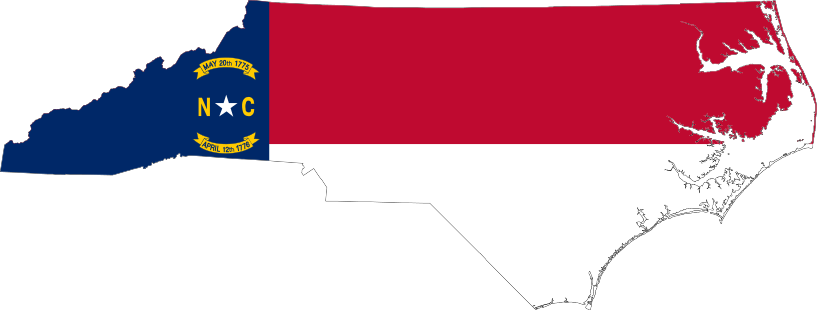
1) Put North Carolina Back in Play


Republicans in North Carolina are more vulnerable than ever now that the Mueller report has been released. The unfortunate collateral damage is being suffered by Senator Richard Burr. Chairman of the Senate Intelligence Committee, Burr had previously been praised by Democrat Mark Warner for reaching across the aisle on the Russia investigation. Now Mueller’s report maintains that Burr passed on to the White House sensitive information from James Comey regarding which White House aides the FBI was investigating. The Raleigh News Observer has already indicated its displeasure. Burr is up for re-election in 2022. 

Facing a strong Democratic challenge in 2020 is Republican Senator Thom Tillis. Tillis was very public about his opposition to Trump’s executive order on the wall, since it usurped Congressional power. He was scheduled to vote that way until the last minute, when the Republican Party threatened him with a challenge in the 2020 primary. He caved in. He is an apologist for Trump on Mueller matters. 

We can pick up a Senate seat in 2020 (helping to take back the Senate) and again in 2022. Donations to a war chest for the winner of the 2020 Democratic primary are growing. Act Blue has a way you can donate to this fund now. One could decide to donate a dollar for each of Trump’s abuses of his office, but who has that kind of money?

2) 
Remember the Lawyers
In fourteen separate instances, the legal action related to the findings of the Mueller investigation will be carried out by federal prosecutors who have received referrals from Robert Mueller. There remains a strong need for lawyers outside of government to step forward and make certain that the public’s interests are protected. The American Civil Liberties Union is an excellent investment in this regard. An uncommon litigator has emerged to expand those interests. The Electronic Privacy Information Center is normally focused on such issues as Facebook violations of consumer privacy. In this case, they have been a valuable proponent for the public release of the report with the fewest possible redactions.

3) 
Understanding What it May All Come Down To
Right now, the likelihood is that resisters will emerge victorious on November 3, 2020. Trump’s disapproval rating is mired in the low 40's, and we achieved a great start last November. Further, the Mueller report shows a manic president pushing every obstruction button he could find, and more than a few collusion buttons. Ironically, he is thought to be in a better legal position because aides devised ways to ignore his orders. Even as he sought to collude and obstruct, he couldn’t always get the job done! One more knock on his leadership skills?

Maybe the Democratic candidates will ding each other more than necessary and maybe by summer of 2020 the polls get a little closer than we want. We can invest in preventing that situation now. Signing up new voters (especially those in the age group 18-30) is not just a matter of sending a check to an organization. Forty states offer online registration. That means in effect that you can become your own personal registrar. You can make it a habit to ask people you know whether they registered. You can get them their online link and check on them to make sure they got it done. 

A number of organizations provide the necessary links for online registration, including Ballotpedia. You can even go one step further, getting large civic minded organizations you know to partner with Rock the Vote to create a customized voter registration page on their websites. 

If you are feeling the urge to put this all down for a little while, read the Mueller report excerpts in the New York Times, or read the whole report. We were never in need of a bit more motivation. But just in case we were wondering whether the threats to our country are so huge as to be worthy of our efforts, we just got the depressing but energizing answer.

David Harrison
Bainbridge Island, Washington

Thursday, April 4, 2019

#63: We are Going to Make It

Thank you for continuing to share these messages with your friends. If you are not already on our mailing list, please click here to be added to our list. You can also follow me on Facebook where you can read and share these messages. The more people we can reach, the more we contribute to this growing movement. We share these posts on our blog, A Path Forward to November 3, 2020, every two weeks, which means there will be a total of 100 missives before the Presidential election of 2020, in which our country will select a whole new course.

No, Donald Trump, you haven’t been the force behind spending $91 billion to respond to the hurricane’s destruction of Puerto Rico. So far, the U.S. government has spent $11 billion, and you still have a hard time remembering Puerto Ricans are citizens.

No, Donald Trump, you did not invent the Veteran’s Choice program, which expands health care choices for those who served. The law was passed in 2014, before you were president. It was advanced by John McCain and Bernie Sanders, among others.

No, Donald Trump, your father Fred was not born in Germany. He was born in New York City. You claimed that he was born in Germany as a part of a lame attempt to bond with Germans after you had clearly misrepresented their natural gas deal with the Russians. Are we wrong to suspect you always knew where your own father was born?

How to explain not just a dance with the truth, but this complete, intentional, perhaps pathological disregard for the truth? One possibility is that when a person is continually lying to seek political advantage he could either go big or go home. An obvious, provable lie stands out when an elected official pledges to earn and maintain your trust. A score of untruths a day, delivered with bluster establishes that the person doing the lying sees himself as having his own set of rules. 

We are in the process of disabusing Donald Trump of the notion that truth ultimately doesn’t matter if you ignore it every day. Why would a Republican Senator or a Trump supporter anywhere in America stand for this, having rejected chronic dishonesty in all other persons? Only 4 of 10 Republicans believe most of Trump’s claims are true. They don’t call him out because they don’t see the alternative. Or. If they do see the alternative, they fear it. They would rather have someone lie on multiple matters and oppose the Affordable Care Act than tell the truth of these same matters and support the Affordable Care Act.

It does help create our huge opening in November 2020, no? Issues that are hugely consequential to voters will turn on which candidate’s claim they believe. They are more apt to vote for the candidate who protects health care for those with preexisting conditions, which Trump hasn’t; to support the candidate who stands up to Russia, which Trump won’t; and to get behind the candidate who will advance the middle class when it comes to tax cuts, which Trump didn’t.

That’s a good start for our candidates, made even better by Trump’s decision to take another run at the Affordable Care Act. The last run helped us take back 40 seats in the House of Representatives. 

To build upon this excellent start, we need to apply some standards to our own candidates. We have lots of candidates, and lots of good candidates, so we can be choosy. Already, our efforts to sort them out are consequential. To qualify for one of twenty! positions in two rounds of summer debates, candidates have to register at least 1% in three polls or get help from 65,000 donors. These conditions are easy to meet, but they are only the first step in narrowing the field. 

What could our selection standards be?
  1. Let’s start by preferring a new generation of candidates for both president and vice president. That doesn’t mean we couldn’t select Bernie Sanders or Joe Biden or Elizabeth Warren, but it would be less likely under this standard. It means that if we can find the right candidates, it would be an excellent time to depend on the next generation, which has already acquitted itself nicely through the presidency of Barrack Obama.
  2. We must show our disapproval for any candidate who re-litigates the 2016 battle for the Democratic nomination. This habit of former Clinton or Sanders staffers disparaging each other can be stopped by us withholding support for whichever present day candidate abets that behavior..
  3. As discussed in previous missives, let’s go with candidates that have a clear, imaginative, principled policy agenda that reflects Democratic values. One way to check this is by reading their books, already put forward by ten candidates. Even a book that doesn’t say anything compelling will tell you something, in its absence of a vision.
  4. Let’s be on the alert for candidates fielding non-substantive criticisms against each other. Obviously Cory Booker is a strong and serious candidate (and Senator) but his criticism of Kamala Harris and Bernie Sanders for “joking” about their pot use is strained. He says it shows they aren’t focused on past sentencing disparities, but he has to know that they are.
  5. We can be discerning about the “take down” articles that appear in the media. As in the recent increase in interest in South Bend mayor Pete Buttifieg (and subsequent criticism of him) let’s see where he stands and what he has done.
  6. Even though we aren’t going to insist that our candidates have extensive executive branch experience (as in Governors Hickenlooper and Inslee) let’s not forget that what candidates have done so far matters. That fact that Amy Klobuchar and Cory Booker have longer and broader records of service (in both the legislative and executive branches) than Pete Buttifieg and Beto O’Rourke is not inconsequential.
  7. Let’s ask candidates not to make broad, unqualified endorsements of sweeping proposals that are addressing critical issues in important ways, but still need work. This includes both the Green New Deal and Medicare for All, which several candidates have fully endorsed.
  8. The rapid judgements of social media can cause an accusation to get way out in front of any means of determining whether the accusation is warranted. Let’s expect candidates to support due process. That’s what we all had the right to expect from Kirstin Gillibrand in her unacceptable race to judgement on Al Franken.
As we apply these standards, we could use our evaluations to inform making some donations or doing some early stage volunteer work. Allegiances can be shifted or strengthened as the field narrows. Our immediate efforts matter. We do not intend to pull defeat out of the jaws of victory in 2020. One way to keep that happening is to engage now. Here are three specific ways to do just that.

1) Reach Across the Chasm


We can win in 2020 without converting a single existing Trump supporter. Nonetheless, it is in the long term interest of our democracy for us to devote more time to understanding the positions of those who disagree with us.

This seems especially important on economic issues. As we painfully recall, the firewall did not hold in November of 2016 as we lost Pennsylvania, Wisconsin and Michigan. Certainly those losses were partly due to Russian interference and to James Comey’s momentum-reversing announcement regarding Hillary Clinton’s email. However, in these three states traditional Democratic voters were not fully convinced that Democrats were as focused on the economic security of the middle class as was Donald Trump. (This of course leaves aside the subsequent massive evidence that Trump’s voiced concern for the middle class was a ruse.)

Our possible common interests in fighting economic insecurity is reason enough to start new discussions with people who feel differently than we feel. Certainly, many of us can find prospects for new conversations among our neighbors, friends, acquaintances and relatives. If we can’t there are a number of organizations that will help us. Time to look into participating in or hosting an exchange through Make America Dinner Again or Living Room Conversations, which has been promoting gap-closing discussions since before Donald Trump was visited upon us. 

2) 
Pay New Attention to the Democratic Party
Right after the November 2016 election, the Democratic party was lost. The licking of wounds was interminable. It took them months to formulate any strategy for taking back the House. In this period organizations like Indivisible and Swing Left stepped forward to organize the resistance.

Now, Democratic party organizations in several states are on the upswing. Even for resisters who do not crave party ties, it is important to understand what this party is doing state-wide and in your local area. You can start by getting on the mailing list of your state Democratic party, or becoming a member.

3) 
Take Advantage of Swing Left’s New Tools
In a timely fashion, Swing Left has devised several tools to make certain that all of us don’t wait too long to engage. These are mostly built around a “super-state” strategy that Swing Left believes will enable us to fight gerrymandering, keep our House majority, win back the Senate, and win the Presidency. These states are Arizona, Colorado, Texas, Michigan, Ohio, Wisconsin, Pennsylvania, Maine, North Carolina, Florida and Georgia. There is plenty of work to do in other states of course, and work to do in super states in the comfort of your own home wherever you are located.

It is definitely worth it to download the strategy and find a way to have Swing Left guide some of your efforts. You can even donate to a fund to provide post-nomination dollars to the Democratic presidential candidate. Of course, that would require you to have full confidence in the results on the nomination process. One of the sad truths is that any conceivable Democrat candidate would be superior to the President we ended up with last time we voted.

Yes, it seems like an eternity to November 2020, when we will be done with Donald Trump. It is comforting that it has been 29 months since he was elected, so we are on the down slope. We’re going to make it.

David Harrison
Bainbridge Island, Washington

Wednesday, March 20, 2019

#62: There are Millions of Us Standing in His Way

Thank you for continuing to share these messages with your friends. If you are not already on our mailing list, please click here to be added to our list. You can also follow me on Facebook where you can read and share these messages. The more people we can reach, the more we contribute to this growing movement. We share these posts on our blog, A Path Forward to November 3, 2020, every two weeks, which means there will be a total of 100 missives before the Presidential election of 2020, in which our country will select a whole new course.

A couple of days in the Trump presidency can tell you a lot about every other day. Ever since John McCain cast the deciding vote in keeping the Affordable Care Act alive, resisters have been pining for more principled action from Republican Senators. As these missives have emphasized, these steps have been too few and too far between. The reasons are clear too--- these Senators would like to be the ones to decide how long they are going to serve. They are afraid that if they say too much or do too much that Donald Trump will poison their essential support among their state’s Republican voters. And they are right to worry about that. Of course the flip side of Trump’s strong party control is an outcome that also has a lot to do with Trump. He may have Republican party loyalty but due to him the percentage of people identifying as Republicans is falling.

Thus, we all glory when any Republican Senator says no to any aspect of this disastrous Presidency. Richard Burr has protected the Mueller investigation, Susan Collins kept the estate tax from being abolished, and several Senators have worked to sustain our commitment to Kurdish fighters battling Isis in Iraq.

Wednesday and Thursday the 13th and 14th were especially intense on these fronts. On Wednesday, 7 Republican Senators voted with the Democrats to temporarily block aid to Saudi Arabia for their war in Yemen. These Senators are upset with the Trump administration’s failure to confront the Saudi’s murder of Adnan Khashoggi. Then on Thursday, 12 Republicans voted with the Democrats to block Trump’s emergency declaration which unconstitutionally seizes appropriated funds for the wall. Trump will veto both actions, but nonetheless it’s momentarily comforting to see these Senators remember their oath of office. The temporary renegades included several nice surprises, including Jerry Moran of Kansas and Roger Wicker of Mississippi.

What happened in between those two votes shows how much further we need to go, and how essential it is to flip the Senate. On Wednesday night Lindsey Graham, Ted Cruz and Ben Sasse decided to head over to the White House to hang out with the President and get him to agree to a deal that would avert the vote against the emergency declaration. Their proposal (which Trump rejected) was that the Senate would assent to this particular crisis-inventing emergency declaration if he would agree to work with them to subsequently narrow the uncommonly broad Emergency Powers Act. The moral bankruptcy of this approach is breathtaking---- “Mr. President, this specific abrogation of the powers of Congress is so repellent to us that we want you to stop doing things like this after we let you do it this time.”

This sorry story demonstrates how hard it is to move the Republican majority in the Senate even when they are profoundly distressed with this or that unknowing or wrongheaded or duplicitous thing that Trump has done. They have held Trump back in his dismantlement of global alliances, and have protected Mueller, but they have no sustained commitment to helping people in need.

Trump’s proposed budget is wantonly uninterested in the un-fed, unsheltered and uneducatedAn administration which was obsessed with giving tax cuts to those with the highest incomes has walked away from the real-life circumstances of those with the lowest incomes. The federal government’s outstretched helping hand has been pulled away.

As difficult as it is to battle for global partnerships and against climate change, resisters face perhaps even greater adversity in fighting for economic opportunity and basic assistance for those with low or no incomes. This is partly because there is nothing even close to a policy consensus about what should be done over time. We need to attend to the absence of a strong, central, affirmative, poverty-battling agenda. New members of Congress tweeting all day long has yet to turn out to be meaningful contribution to this agenda. Hopefully everyone we elected last fall will get increasingly focused on specific steps. Here are three things we can help them do:

1) Fight for Food Security


Last fall, we had a major victory when Democrats led by Senator Debbie Stabenow of Michigan blocked an onerous Trump administration proposal which could have thrown nearly a million people off of food stamps. This program is now called SNAP, the Supplemental Nutritional Assistance Program.

The bulk of the Trump-targeted recipients have received waivers of work rules, which otherwise would limit SNAP assistance for those who have employment or are actively seeking it. The catch is that these of our brethren are the most unskilled, the most addicted, and the most unhoused of our population. The plan should be not to hide the food but to guarantee provision of food and shelter as the underpinning for any goals they have for themselves or the rest of us have for them.

Defeated in the Farm Bill, the Trump forces have come forward with a proposed change in the waiver granting rules carried out by the U.S. Department of Health and Human Services

It is unclear whether the President and HHS have the executive powers to establish this rule without Congressional action.

It’s time to engage on these matters in an ongoing way. Feeding America is an ideal agent for our increased attention. They are the association of America’s food banks. They will keep you informed, but they will also help you to file a public comment on the proposed rule! 

2) 
Sharpen and Strengthen our Tools for Income Support
Nearly all of the Democratic presidential candidates correctly see income supports as an important way to mitigate wealth maldistribution. As these efforts grow, it’s essential to be much more grounded in the options to improve this significant step in the pathway out of poverty. The most ambitious approach is Universal Basic Income (UBI), which provides guaranteed income to all. As is the case with many a bold proposal, this approach is very expensive and there is a worry of researchers that it would be a disincentive to work.

However, UBI can energize the income support question. Where does income support fit within the world of poverty-battling strategies, including those focused on homelessness, education, food support and asset building? Who would qualify and at what level? How can we use income support to reduce our egregious wealth disparities?

A previous missive underscored the usefulness of expanding the Earned Income Tax Credit as a first step down this longer path. This tax credit for low income working families is the most effective income support tool, and thus the best instrument for building broader and more generous support. Sherrod Brown and two House members--- Bo Khanna and Bonnie Watson Coleman are the strong advocates for strengthening the EITC.

It would be good to get Presidential candidates to do more advanced work on these matters. Why not email one or more of these Senators at their Senatorial offices and see how they are handling income support issues? Make them get more specific by asking whether they are helping to expand and improve the Earned Income Tax Credit.

3) 
Get Started With Flipping Arizona
Republican Martha McSally lost to Democrat Krysten Sinema in November, but then was appointed by the Governor to fill John McCain’s vacant seat. This is a prime seat for us to pick up next November, not least because Donald Trump pushed a reluctant but dependent McSally into supporting his executive order.
Two strong candidates have already emerged to oppose McSally. These are former astronaut Mark Kelly and member of Congress Ruben Gallego.

The way to get started is to keep up the relentless voter registration efforts that helped elect Synema, and which are emphasizing Latino Voters. There is an excellent coalition-driven organization that has taken this all on, called One Arizona. The more we can boost them financially, the more voters they will be able to register, and the better our chances in 2020. 

Donald Trump knows all of us are out here. He can go to the campaign rallies of his most loyal believers all he wants and abuse the facts and soak up the cheers. But, we are working harder each and every week, there are many millions of us and we are standing in his way.

David Harrison
Bainbridge Island, Washington

Wednesday, March 6, 2019

#61: Put the Resistance in Every Scene of This Drama

Thank you for continuing to share these messages with your friends. If you are not already on our mailing list, please click here to be added to our list. You can also follow me on Facebook where you can read and share these messages. The more people we can reach, the more we contribute to this growing movement. We share these posts on our blog, A Path Forward to November 3, 2020, every two weeks, which means there will be a total of 100 missives before the Presidential election of 2020, in which our country will select a whole new course.

Certainly, it is difficult to avoid becoming numb. Donald Trump has escalated his affronts to the constitution and to any conceivable acceptable standard of presidential behavior. Just when you thought he could not be more of an unknowing, incurious, unprincipled con man, he finds a new thing to do or say that to this point would not have been thinkable. 

Once he takes the step of vouching for Kim Jung Un’s character and exempting him from involvement in the death of Otto Wambier, one sees that Trump has reached an all new level in the admiration of autocrats and ignorance of history. It is not an exaggeration to say that as World War II brewed in 1937 Donald Trump would have offered Benito Mussolini a golf game, praised his governmental leadership, and remarked about the warmth of their relationship.

As conservative commentator John Podhoretz reminds, on human rights issues Republicans have been divided over decades between those that want their President to carry the beacon of justice wherever they go, and those that want their President to practice “realpolitik” where he or she is clear-minded about our autocratic adversary’s ethical limitations. Now that we have seen Trump with Putin, the Saudis, Erdrogan, Duterte, and Kim Jong Un, we realize that he does neither - when he is face to face, he does not recognize human rights violations, including the Khashoggi and Wambier deaths, and neither he does he recognize the autocratic leader is anyone different than Angela Merkel, especially if he has received nice notes and generous toasts from them.

When a level of malfeasance becomes this bizarre, we must overcome our numbness and accelerate our activism. We are not sitting in a theatre watching a drama unfold on the screen. We are a part of the picture, and not just in the crowd scenes. We are putting the resistance in every scene. The level of that resistance has been epic, and it must grow. And, we must continue to attend to unthinkable behaviors not just in the world of Trump, but in the world around him.

In the broader world around Trump, craziness emerges which might once have been checked. Former Hilary Clinton aides and Bernie Sanders aides snipe at each other as if we should care about their recriminations. Say to them “Excuse me, but haven’t you noticed we’ve moved forward?” Tell them that what we have going on now is far too important for us to care about their backing and forthing. Tell them they are not nearly as important as they think they are.

Social media gets overwrought at Diane Feinstein’s condescending approach to school kids, but no one tells the teachers and parents that kids are not their pawns. Who reminded these young people that the specific provisions of the Green New Deal matter must be debated, and need the work that Democrats intend to carry out? Even in 2019, social media participation does not represent a legislative process.

There is so much happening all at once. Three grossly unacceptable approaches stand out and must be resisted. First, in the United States Senate, ten Republican Senators who remember their oath of office are desperate to find a way to adhere to that oath while still countenancing Trump’s emergency declaration. Their newest trope is to pretend that the declaration is like the declarations of the past which have gone uncontested. The opposite is the case. This is the first use of emergency powers to intervene in an appropriations dispute and thus obliterate Congress’ constitutional prerogative. To swipe $6 billion from the military construction budget, the Pentagon must certify that the wall building construction funds are necessary to provide support for troops in the field! So, the made up reason to send troops to the border now generates the made up reason to seize appropriated funds. It is one of the reasons why General Mattis walked away. As much as it pains them, we can get some more Republican Senators to walk away too. 

Second, we face a new episode in Howard Shultz’ vanity project, running for President. Even after it was reported that he had voted in just 11 of the past 30 elections (in a state that has mail-in ballots!), he skipped a Seattle schools levy vote in February. And after that, he commended voters who have “perfect” voting records. Howard, we are not dismissing you because you are not perfect. On the matter of civic commitment, which must be a prerequisite for any candidacy, we are dismissing you because of the chasm between you and perfection. Your non-participation makes us all think you feel entitled to our attention, whatever your civic record. We will continue to note that you are not.

The third affront is even more surprising, because it comes from within. The emergence of Indivisible after the November 2016 election was a splendid thing. Indivisible started forming hundreds of local activist groups immediately, and thus in the early stages defined our collective way forward. Who knew that there would come a time when we would have to resist the resisters? Indivisible has decided that the Senate should abolish the filibuster, and with it the requirement that 60 voters be garnered to close the debate. They reason that when we take back the Senate the cloture provision will be an obstacle to the necessary, monumental work on climate change.

This is not a matter of asking Indivisible’s leadership to remember times in past decades when the Democratic minority was able to keep the country from doing this or that awful thing. It is time to remind Indivisible about the value of giving some power to the minority last year and this year and today. If 50 voters in the Senate had been king these past two years, every shred of the Affordable Care Act would have been repealed by now, including the Medicaid expansion for people with little income and no health care. If 50 votes were king, last year McConnell and Paul Ryan would have given Donald Trump $25 billion for the entire wall. On this one issue, as Pogo said, “We have met the enemy and they are us.” We are going to win back the Senate in the fall of November 2020. Doesn’t it seem a certainty that we will not hold it forever, that sometime in the future we will be desperate for the minority to have standing?

In response to these affronts, let’s do these three things right away:

1) Get Even More Votes to Block the Emergency Declaration


Very, very slowly, Republican Senators are increasing their opposition to Donald Trump’s worst excesses. The country needs them to do far more than they have done and are bound to do, but it still is not a bad thing when one or more of them stand up. The reason they don’t do it more often has been thoroughly outlined in previous missives. It’s a matter of self-preservation. It is not clear that any Republican Senator can win re-election after persistent, principled opposition to Trump, because a significant part of their Republican voters will fall away. Susan Collins has to test this proposition. If she doesn’t challenge Trump, a significant part of her Independent supporters will fall away. And what will happen to Colorado Senator Cory Gardner on this front?

The House has passed the resolution temporarily blocking Trump’s emergency declaration. It looks good in the Senate, since we already have gained the votes of Lisa Murkowski, Susan Collins, Rand Paul and Thom Tillis. No complacency please. Vigilance is the price of liberty.

How many other Republican Senators we can get matters because it builds strengths for future battles. This is especially the case in the area of protection of global alliances, where Republican Senators weep into their pillows each night over the damage Trump has caused.

Let’s keep the pressure up, emphasizing five Senators who will not be able to stay on the fence much longer. The rules of engagement still pertain. If you have a wiggling home state Senator, always call or email her or him first, even if you have done so a hundred times already. If you are contacting a Senator who is not from your state, strive for as much human contact as you can get, but remember even being included in the “count” of their calls matters, because it is tallied in a regular report to the Senator.

Emphasis on these five fence-sitters would be useful:
  • Cory Gardner of Colorado (the most vulnerable Republican incumbent in the 2020 elections): (303) 391-5777
  • Ben Sasse of Nebraska (intellectually strong and not unwilling to criticize Trump, though his votes in opposition are rare): (402) 550-8040
  • Lamar Alexander of Tennessee (a principled man who isn’t running for re-election, but is still trying to talk himself into voting the wrong way): (901) 544-4224
  • Martha McSally of Arizona (already facing re-election because she is completing John McCain’s unfinished term): (602) 952-2410
  • Mitt Romney of Utah (who is still feeling his way): (801) 524-4380

2) 
Keep Up the Heat on Howard Shultz
Howard Shultz does want you to think well of him and he wants your support, which hopefully is unavailable. It’s hard to find, but there is a way to avoid vitriolic organized campaigns and tell him your views directly - here’s his contact page 

As you can see, you can fill in your personal comment or admonition in your own words. One thing to tell him is that every single day Donald Trump wakes up in the morning hoping fervently that he will enter the race.

3) 
Change Indivisible’s Course of Action
The work of Indivisible has been exemplary. As expressed by co-president Ezra Levin, their ideas about doing away with the filibuster are nonsensical.  

One could read recent American history for five minutes and understand why this is an awful idea. Yes, getting to sixty votes on climate change once we take back the Senate will be difficult. Yes, the globe is at risk. So, let’s get to it and get it done. Eliminating the leverage of the minority which has been so indispensable to us in these troubled times is not the answer, and Indivisible should know better. If you are in an Indivisible cell, please raise this issue. If not, make your thoughts clear by writing Indivisible at contact@indivisible.org.

All of us working together made possible the House majority and thus the subpoena power wielded by Elijah Cummings, Jerome Nadler and Adam Schiff. What we will learn on multiple fronts regarding Trump corruption and Russian collusion will rock the country. And in the face of it we will continue our relentless pursuit of the protection of the imperfect, aspiring American democracy.

David Harrison
Bainbridge Island, Washington

Wednesday, February 20, 2019

#60: Motivate Republican Senators to Get Right with the Constitution

Thank you for continuing to share these messages with your friends. If you are not already on our mailing list, please click here to be added to our list. You can also follow me on Facebook where you can read and share these messages. The more people we can reach, the more we contribute to this growing movement. We share these posts on our blog, A Path Forward to November 3, 2020, every two weeks, which means there will be a total of 100 missives before the Presidential election of 2020, in which our country will select a whole new course.

If we aren’t careful, we could talk ourselves into the wrong points of view. That would leave us less powerful at a time that we need to gather and utilize our power.

For instance, we could hear that the unenthusiasm of Queens residents for Amazon’s 25,000 jobs is some sort of indicator for how liberals and progressives think about jobs and economic growth in their own communities. But the fact is that Amazon intended to replace that community, not just bring it new economic opportunity. And for Queens and New York to have demonstrated their appreciation for having their community change dramatically, they would have needed to accede to a huge corporate assistance tax package.

We could hear that the Green New Deal is a socialist dream that will eliminate the support of independent voters for a Democratic candidate. But what it represents is the very beginning of an aspirational discussion. Its ideas will be modified and dealt with separately, not as an omnibus bill. Nonetheless, it is one part of an overdue exploration of how we can together boldly change the way America addresses (or ignores) its environmental future.

Similarly, Medicare for All is the platform for big believers and big dreamers, trying to confront the continued malfunctions of the American health care system, improved but by no means fixed by the Affordable Care Act. It represents the start of a new conversation, not the end of one.

Figuring out which Democrat to nominate for president is a huge decision. We can’t get that done by determining who has the best slogans or even the most combative attitude toward Donald Trump. What we most need is this marketplace of ideas, including any number of ideas that have been hidden or besmirched since Republicans took over the Congress in 2010. We can’t pick a president without understanding some of the finer points of how they differ from the other people who want to be president. We have more than a year to figure this out.

Policy ideas also force us to understand the distinctions between show horses and work horses, between elected officials who are authentically seeking reform and those who are too fully aware of the camera. Happily, Thomas Perez and the Democratic Party leadership are crafting rules for genuine televised debates where ideas are exchanged. The New Hampshire primary and Iowa caucuses will be great testing ground for which candidates have ways of thinking that are especially compelling, since success in these states depends upon meeting at length with small groups whose members ask pointed questions.

Since several of the candidates are Senators, we need to be able to sort out legislative proposals offered by Democratic leadership or by candidates to understand whether they have any particular significance.
  1. Some proposals are meant only to stake out a position. Elizabeth Warren has proposed a wealth tax of 2% on assets over $50 million. The revenue would be used to fund child care support. There will be other candidates weighing in on how to assign a greater tax burden for the rich. None of their specific proposals will be advanced in the House, but they are useful for determining where the candidates stand, and how their position varies from that of other candidates.
  2. Some proposals are intentionally broad in scope and are intended to grow a movement. This is the significance of both Medicare for All and the Green New Deal. They are aspirational and designed to lead over time to monumental change in the way things are done. At this point, they should spur debate, not end it. That’s why several Democratic presidential candidates endorsing the Green New Deal is dismaying. These candidates should be contributing to its design, not pretending it should be passed tomorrow.
  3. Of special interest at this juncture are proposals that are being crafted to pass the House and be sent to the Senate, partly as a strategy to hold the House and seize the Senate in 2020. These proposals will be important legislative approaches on issues like voting rights, prescription drugs, and better protection for those with pre-existing conditions. They are not expected to become law, because Trump can veto them. They are being designed to either win over the four or five Republican Senators needed for passage (prior to the Trump veto), or to elicit political damage for the 12 or 13 Republican Senators thought to be vulnerable in November, 2020. As versions of them are debated in the Senate, they will also provide a window on the passion and creativity of candidates/Senators Gillibrand, Klobuchar, Booker, Sanders, Brown and Harris.
  4. In a few instances, the House version will represent a major element in a legislative compromise which is likely to become law. This is the case with the recent bill that Trump bitterly signed and could happen with prescription drugs where both parties are committed to passing legislation.
The current dispute over Trump’s declaration of a national emergency falls squarely into category three. We will need at least four Republican votes in the Senate to temporarily block the declaration but would have no way of getting the twenty Republican votes we would need to override a subsequent Trump veto. Even so, it is important that we get the Senate (as well as the House) to go on record against the emergency declaration. This is why. It is a made up emergency. The emergency powers that Congress granted were never intended to be used for an appropriations dispute. Even more critically (and ultimately of greatest interest to the Supreme Court) it would represent a massive usurpation of the powers of the purse reserved to Congress in the Constitution.

Trump is doing improv. Mexico will pay for it until they aren’t paying for it. It is already being built but we need to start building. He could have waited but he needed the emergency declaration to do it now. The truth is that if Trump had not turned on Rush Limbaugh on a certain night in December, none of this would have happened. It is not worthy of the country that we love and the democracy that we defend.

So, we need to do these three things now:

1) Put Pressure on Republican Senators to Get Right With the Constitution


Nate Silver’s 538 has done an excellent job of charting where Republican Senators stand on Trump’s declaration. He counts six Republican Senators as opposed. These include Lamar Alexander of Tennessee, who is retiring, and Rand Paul of Kentucky, who has his own way of thinking about most everything and may not be persuadable through any pleas we can muster.

That leaves six Senators who have already said they are opposed to the declaration and need to be helped to maintain their resolve. Let’s go in the side door by calling as many of the main district offices of these six as we can. Please tell these six that they are being called upon to protect the fundamentals of governing in America, and that you are proud that so far they have stood for what is right:

Ben Sasse of Nebraska: 402 550 8040
Lisa Murkowski of Alaska: 907 271 3735
Susan Collins of Maine: 207 780 3575
Marco Rubio of Florida: 305 418 8553
Thom Tillis of Nebraska: 704 509 9087
Pat Toomey of Pennsylvania: 215 241 1090

Then, as we work through our calls, we will realize that we are getting good at this, and we will decide to call a Senator who has expressed concerns, who is on the fence, and who is very worried about getting re-elected a year from November:

Cory Gardner of Colorado: 305 418 8553

2) 
Help with Recruitment to Take Back the Senate
We already know the blueprint, since we used it to take back the House in 2018. Coming up, we have a much more favorable map, with 23 Republican Senators up for re-election, and with up to 13 seats worthy of being heavily contested. Last time, we made massive gains among younger voters, independents, and suburban voters. We did that by letting Trump be Trump, by recruiting excellent candidates and by making millions of small contributions.

We have an excellent candidate to recruit. We almost got Stacey Abrams over the top in her effort to be Governor of Georgia, but we were stymied by voter suppression. Now she is seriously considering running for the Senate in 2020. She needs our encouragement. You can start by getting her mobile alerts.

3) 
Make Certain Legal Action is Relentlessly Pursued
The first thing to accomplish on the legal front is for multiple parties to file actions in federal courts challenging the emergency declaration. Eventually the cases will be consolidated. This is the rare case where “all the way to the Supreme Court” will surely come to pass, because the Supreme Court justices will not permit such an unusual and important case to be resolved at the federal appellate level. Among the emerging litigants, the consortium of 16 states and the American Civil Liberties Union already loom large.

The ACLU is litigating on behalf of the Southern Border Communities Coalition. This Coalition includes sixty organizations serving border communities from Texas to California. It’s worth following and boosting, because we all will be pursuing fair and just border policies for some time to come.

If it weren’t such a dismaying and even frightening time, you could say all of this is exciting, no? We don’t have to worry for even a minute about being able to find consequential work to do. It’s there before us. It wouldn’t be overstating to say a nation hangs in the balance.

David Harrison
Bainbridge Island, Washington

Wednesday, February 6, 2019

#59: Let’s Get Out of the Bleachers and Back onto the Field

Thank you for continuing to share these messages with your friends, if you are not already on our mailing list, please click here to be added to our list. You can also follow me on Facebook where you can read and share these messages. The more people we can reach, the more we contribute to this growing movement. We share these posts on our blog, A Path Forward to November 3, 2020, every two weeks, which means there will be a total of 100 missives before the Presidential election of 2020, in which our country will select a whole new course.

We are focused on politics and government, and we are worried about how our nation will recover from recent wounds and prevent new ones. Even after the high of November 6 when we flipped the House and presented Donald Trump with a fully re-empowered Nancy Pelosi, some days bring us down, as Trump’s made up stories, bullying, full scale con job, self-delusions and dangerous actions overwhelm.

In the face of all this, one would think that there would be no retreating from the front lines of political action to the sidelines of political observation. The rewards of the monumental efforts of the resistance are so evident, how could any of us step back? What happens is that necessarily we have let life intervene. We feed our souls, earn a wage, tend to our relationships, and immerse ourselves in the natural world. We really don’t have a choice about doing these other things if we are to stay strong and sane.

But if we get too far up in the stands, we will end up thinking that watching Rachel Maddow or Shields and Brooks or podcasts is some kind of substitute for action. Which it isn’t. Letting the rest of the resistance do the resisting for a while erodes the required and immense scale of our effort. It can’t be maintained if we fill up the bleachers.

What can we do now if we stay on the field? We can give early money because it is like yeast. State legislators will not be sufficiently focused on fighting voter suppression unless we make it so. Senators who could cast an important swing vote have to know that we are out here. In 2019, we must recruit, vet and support candidates, register voters, and welcome new 18-year olds. There are postcards to be sent, places to be, information to be examined, and passion kindled. It is the gargantuan scale of our effort in 2017 and 2018 that underscores the vital work that has to be done. Which of us wants to take November 2020 for granted? Perhaps we have already learned the risk of that.

We can take advantage of the notable, continued deterioration of Trump’s support in the country. That slow slide is evidenced not just by the polls but by the tiny but still altogether new steps by Republican Senators. The six voting to re-open government gave the Schumer/Pelosi contingent more votes than the Trump/McConnell approach, and that outcome was an element in Trump giving in. Cheers to Susan Collins, Mitt Romney, Lisa Murkowski, Cory Gardner, Johnny Isakson, and Lamar Alexander. The next step for them is to build upon their resolution in the Senate on the Middle East and demonstrate to Trump that their party exists outside of him. Or does it?

On the field, we can treat the policy debates within the Democratic Party as necessary grist. Why not understand the merits (and demerits) of the possible elements of Medicare for All? We can have that debate and defend Affordable Care Act protections of pre-existing conditions in the same year. Is it necessary for Medicare for All proponents to jettison the considerable employer-provided insurance that is still out there? What would happen to the programs and conditions under which current Medicare recipients function? At this point let’s advocate alternative approaches to major health care reform, rather than being expected to swear a blood oath. Are we out of practice in demonstrating how ideas are developed and elevated? 

Media emphasis on the political battles themselves obscure the weight of the underlying ideas regarding what government should do. As much as we extol Nancy Pelosi’s strategizing, her refusal to counter-offer during the shutdown could have been politically damaging and unsuccessful. It didn't turn out that way because the American people had not bought into the idea that the wall is necessary, and no Trump warnings and pronouncements changed their minds.

So, since the actual ideas matter, it is time to move aggressively to help disabuse Howard Schultz of the notion that he will run for president. Is there a single passion or policy proposal that Howard Schultz holds dear, other than the desire to be elected? If what has happened to motivate him to run is the danger Trump presents to America, why would he heighten that danger? Our collective disapproval should be made clear to him for as long as it takes. 

Then we can turn to the best part of the election process. We have an extremely healthy and growing field of candidates. Because Democrats don’t have “winner take all” primaries it is going to be hard for any top tier candidate to open up a delegate lead. All the more reason to dig deep into candidate positions, and to not get fully taken by “liberal” and “progressive” labels. Because of the detail and nuance in their policy positions, it would be impossible to reliably place these candidates on a political continuum. So let’s make a point to understand candidates beyond the information that is most readily available.

After unsuccessfully running Al Gore, John Kerry and Hilary Clinton from Trump’s generation, let’s go younger and fresher. That might allow us to lay down a new case for how America can move forward, and keep us from having to promote a candidate who is already fully defined. However much we love them, or don’t love them, that would make us less interested in Joe Biden, Bernie Sanders, and Elizabeth Warren. And let’s require our candidates to know something about the Constitution and the management of government. Kamala Harris, Sherrod Brown, Cory Booker and Amy Klobuchar all had state or local executive branch positions before heading to the Senate. We can win in 2020 without the vote of a single Trump supporter. Nonetheless let’s select someone who has superior communication skills, who has a story to tell and knows how to tell it. As an example, here’s what Kamala Harris accomplished with her roll out.

We must set a personal standard for ourselves that demands meaningful political engagement every single week. Right now, there are three things we can do:

1) Shut Down the Shutdown


Trump is still in a corner with regard to the wall. When Nancy Pelosi says there isn’t going to be any money for the wall, it is not a flexible position. She doesn’t have to agree to a wall, so she won’t. The only possible compromise that Senate Appropriations veterans Pat Leahy and Richard Shelby could possibly come up with is a few hundred miles of fencing, coupled with budget increases for technology and judges and some sort of “humanitarian” assistance. Trump’s choice will then be either to 1) pretend such a deal is a victory for him when everyone else will know that it is not, or 2) declare an emergency under the National Emergencies Act. That would set up not only a court battle but a likely legislative show down because the act provides an opportunity for Congress to reject the emergency order. 

If Pelosi engineers such a vote in the House, McConnell would be hard pressed to defend Trump in the resultant vote in Senate. Senators take a dim view of the expansion of presidential powers, and they suspect that there will be a Democratic president sometime in the not distant future who might employ such an expansion. It’s definitely time for some calls to Republican Senators reminding them that building the wall is not an emergency and that it is inappropriate for them to countenance the President using these emergency powers. It is not out of the question that we would get the eight more votes from Republican Senators we need beyond the six named above who already voted to reopen the government. Please call these three, who worry about the expansion of presidential powers:
  • John Thune of South Dakota (202) 224-2321
  • Ben Sasse of Nebraska (202) 224-4224
  • John Kennedy of Louisiana (202) 224-4623
2) Persuade Howard Schultz to Do the Right Thing
There is nothing wrong with polling expert Nate Silver saying that Democrats are incorrect to automatically assume that Howard Schultz’ possible candidacy would be a giant gift to Donald Trump or (for that matter) any Republican candidate. The thing is, given the existing malfunctioning presidency, why even think of taking this risk? This is serious business having to do with the future of our country. This has nothing to do with the possible benefits of a third party in America. All this particular quest is about is a man with money and time on his hands trying to find a way to run for President, now that he has decided he can’t succeed in the Democratic primary process.

Right now, the Howard Schultz website is his pre-announcement campaign center. There are seven upcoming book tour appearances and more to come after that. It’s time to go to one of his appearances and stay outside with a Don’t Run sign. The more we can sustain the narrative that millions of people are intent on Howard Schultz not running, the less likely he is to run. You could also use the existing site to email him your feelings on these matters, but you would have to sign up first, exposing yourself to entreaties.

3) 
Now that Federal Workers are Getting Paid, Who Else is Out There?
When you are living paycheck to paycheck, it is a big hardship to go without pay, even if you know that ultimately you will be compensated for that pay period. The media did a good job of underscoring this misery, and Commerce Secretary Wilbur Ross did a good job of showing that the Trump administration knows nothing of any such hardship. It’s a positive that many of these 800,000 workers have good jobs. It is also a positive to remember after the shutdown is over that many million more Americans don’t have any such job or any immediate chance of getting one.

At the core of poverty battling initiatives is the Earned Income Tax Credit (which supporters have re-branded as the Working Families Tax Credit.) At the federal level and in 29 states, this tax credit boosts the take home pay generated by lower wage jobs. It’s time to check your state and see how it is doing in providing a generous credit. That can generate some questions you would want to ask your state legislators.

It is in the nature of collective action that you could get swept up by a group. They could accomplish great things while you are cheering them on. You could be thrilled with the results, even if you didn’t end up contributing very much to the joint effort. In that case, you are a “free rider.” Or maybe you get in a group seeking great things, but which ultimately does not achieve the desired result because everyone thinks everyone else is going to do the hard work. This would be regrettable, and it is preventable.

David Harrison
Bainbridge Island, Washington